





Tire Maintenance Tips
Wheeler Motors - Vehicle Tires Maintain in Cheboygan
How To Read Your Tire Size & What It Means
Ever wonder how to read your tire size, and what those numbers and letters printed on your tires' sidewalls actually stand for? Tires are one of the most important parts of your vehicle, so you should know as much as you can about them, and there is no better place to start than understanding how to read tire size.

Finding the Tire Size
This part is pretty simple. You can find the tire size listed right on the sidewall of the tire. It will be a combination of numbers and letters and will look something like the picture above.
Service Type - P
Most tire sizes are preceded by a letter that identifies the type of vehicle or type of service that the tire is designed for. The letter is typically a "P" signifying "P-metric," which are tires intended for passenger vehicles.
Another common service type is "LT" which signifies Light Truck, and are designed for vehicles that can carry or tow heavy cargo such as pickup trucks, sport utility vehicles, and full-sized vans.
Tires that do not begin with a letter are referred to as "Metric" or "Euro-Metric" sizes.
Section Width - 205
Following the Service Type, we have a three digit number called the Section Width. This number is basically the tire width measured in millimeters. In our example we have a section width of 205, which means that the width of the tire is 205 millimeters (from inner sidewall to the outer sidewall).
Aspect Ratio - 55
After the section width there is typically a slash and a two digit number called the Aspect Ratio. The aspect ratio is a number that indicates the height of the sidewall (from the edge of the inner rim to the tread) in relation to the section width.
In our example we have an aspect ratio of 55, this means that the height of the sidewall is 55% of our section width of 205mm.
The higher the aspect ratio - the higher the sidewall, the lower the aspect ratio - the lower the sidewall. You may have heard the term "low-profile tires;" these are tires with low aspect ratio, meaning they have very low or "thin" sidewalls.
Internal Construction - R
The letter after the aspect ratio signifies the internal construction of the tire. In our example (as with almost all tires sold today) there is an "R" which stands for radial.
Wheel Diameter - 16
Next, we have the two digit number after the "R". This number is the wheel diameter measured in inches, and refers to the size rim that the tire fits on. In our example the tire would fit on a 16" rim.
Service Description - 91H
Although not really part of the tire size, there is a number and letter group called the Service Description that can be found following the wheel diameter.
The service description is comprised of a two or three digit number and a letter. The number is the Load Index, which signifies the load carrying capabilities of the tire.
In our example we have a load index of 91, which means that the load capacity of the tire is equal to 1,356 pounds.
The letter after the load index is the Speed Rating and refers to the maximum speed that a tire has been tested to withstand. The "H" speed rating in our example means the tire is rated for a maximum speed of 130 MPH.
Tire Rotation
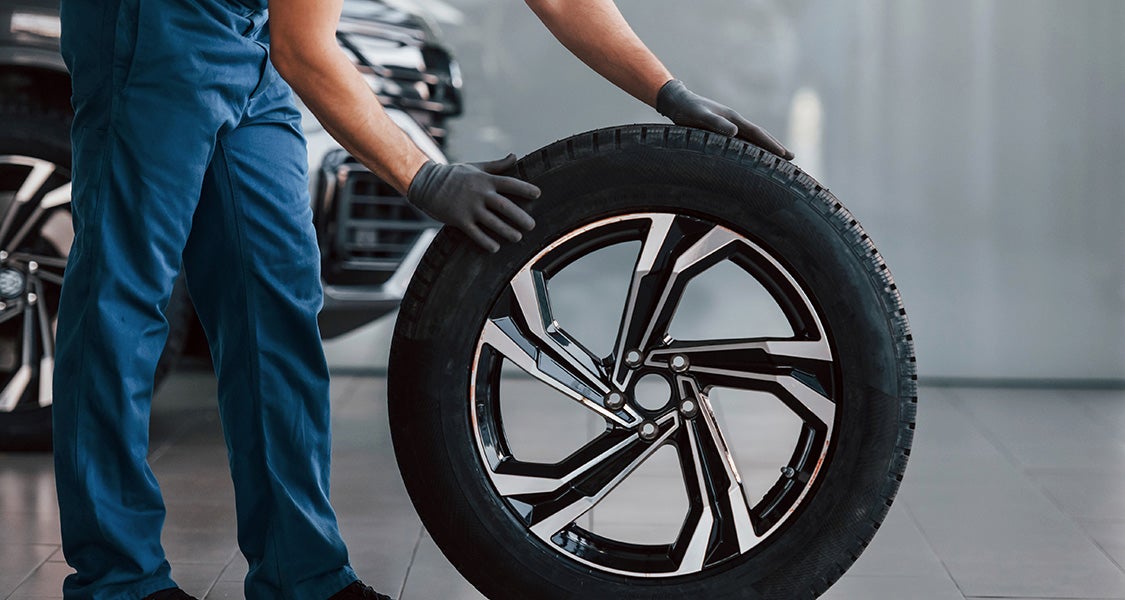
Rotating your tires periodically is an essential part of tire maintenance. The main purpose of regularly rotating tires is to achieve more uniform wear for all tires on the vehicle. If no rotation period or pattern is to be found in your owner's documentation, rotate your tires at least every 6,000 miles and follow one of the suggested patterns below.
Don't include your temporary spare in any tire rotation; it's for emergency use only, but don't forget to check the air pressure of your spare.
If you do have a full size spare and wish to include it in the rotation, use one of the patterns below and insert it into the right rear position. Place the tire that would have gone on the right rear in the trunk as the new spare.
Remember that certain tires cannot be rotated in the patterns described. These include tires with asymmetric or uni-directional tread designs. Also, some vehicles are equipped with different size tires on the front and rear axles. Check the owner's manual for the proper rotation in these cases.
Air Pressure - The most important item on the list
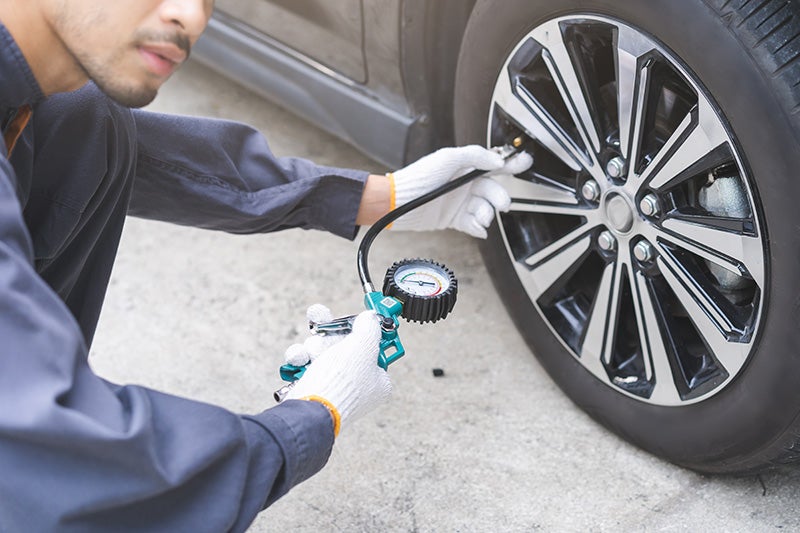
With the right amount of pressure, your tires wear longer, save fuel, enhance handling, and prevent accidents. Failure to maintain the correct pressure can result in poor gas mileage, reduce tire life, affect vehicle handling, and cause vehicle overloading.
Check the air pressure in your tires every other time you stop to fill up at the gas station. That interval will allow you to check your tire pressure consistently enough to maintain recommended air pressure.
The correct air pressure can be found in the vehicle's owner's manual or on the tire placard (attached to the vehicle door edge, doorpost, glove box, or fuel door).
Only Replacing 2 Tires?
The tire industry recommends mounting them on the rear for your safety.
The worn rear tires have less tread and lower hydroplaning resistance. They can lose their grip on wet roads, causing the rear end of the vehicle to swing around out of control.
Deeper tread with greater hydroplaning resistance helps new tires grip wet roads. The driver can steer to compensate for the lower wet traction on the worn front tires and safely maintain control.
Tire & Wheel Plus Sizing
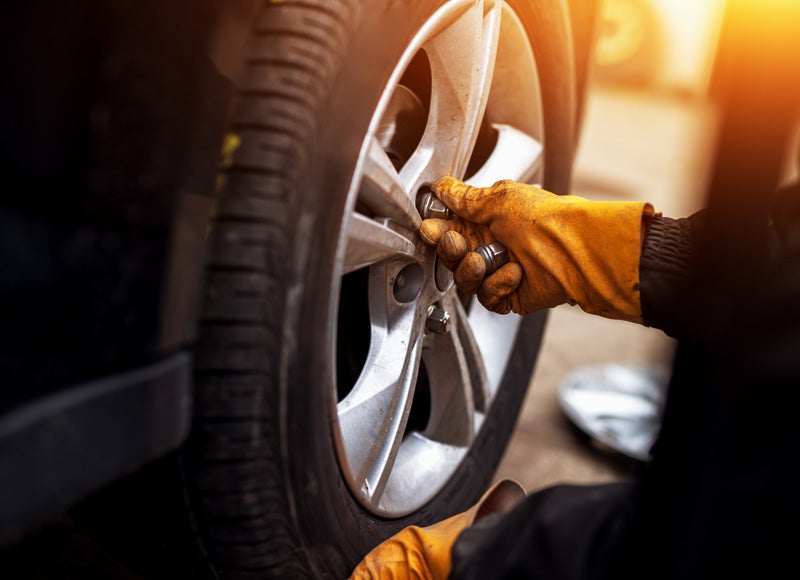
Plus sizing is one of the easiest ways to achieve enhanced performance and improve the appearance of your vehicle.
If a 15x7 wheel with a 205/65R-15 is considered original equipment size, then converting to a plus one size would mean increasing the wheel diameter by one inch to 16x7.5 and selecting an appropriate tire to fit (225/55R-16). It is important to note that although the wheel diameter is increasing, the overall diameter of the tire remains consistent.
Two things happen to the tire to increase performance when moving into plus sizes:
1. The tire becomes wider due to an increase in section width. This creates a larger footprint and more contact with the driving surface.
2. The aspect ratio is lower, resulting in a shorter sidewall. The combination of these changes offers better lateral stability and increased steering response.
Speed Ratings
A tire receives its speed rating from the U.S. government through meeting minimum standards for reaching and sustaining a specific speed.
In general, a higher speed rating will result in better car handling.
Two important notes when considering speed rating:
1. We do not recommend downgrading the speed rating of your tires. This may result in poor handling and unpredictable steering.
2. Never mix and match tires with different speed ratings on your vehicle. This will cause serious problems with the handling of your vehicle. A list of speed ratings can be found here:
- B - Up to 31 mph
- C - Up to 37 mph
- D - Up to 40 mph
- E - Up to 43 mph
- F - Up to 50 mph
- G - Up to 56 mph
- J - Up to 62 mph
- K - Up to 68 mph
- L - Up to 75 mph
- M - Up to 81 mph
- N - Up to 87 mph
- P - Up to 94 mph
- Q - Up to 100 mph
- R - Up to 106 mph
- S - Up to 112 mph
- T - Up to 118 mph
- U - Up to 124 mph
- H - Up to 130 mph
- V - Up to 149 mph
- W - Up to 168 mph
- Y - Up to 186 mph
- Z - 149 mph and over
Determine When You Need New Tires
Tires are considered to be worn out at 2/32 inch minimum tread depth.
In wet conditions, 4/32 inch or less tread means a significant loss in wet traction due to shallower grooves and sipes.
In snow conditions, traction noticeably diminishes at 6/32 inches tread depth. Shallower lug and groove depths limit a tire's ability to "bite" into snow and clean out snow compressed into the tread.
Irregular wear necessitates early tire replacement.
Life Of Your Tires
Replace old tires even if there is tread remaining.
Vehicle manufacturers recommend replacing tires at 6 years.
Tire manufacturers' warranties expire at 6 years.
Tire manufacturers recommend replacement at 10 years.
Industry experts recommend replacement at 10 years.
Proper Cleaning of Your Tires
When cleaning your tires, use a soft brush and be careful around the edges of your wheels.
You can use special cleaners, but typically the mild detergent that you are washing your car with works well when you use a brush.
After washing your tires, dry them and apply a tire dressing. This will enhance the beauty of your entire vehicle and will help prevent the exposed sidewall rubber from cracking or checking.
Consumer Advisory: Factors to Consider in the Life of Your Tires
The following elements each play an important part in your tire’s safety. Throughout the life of the tires it is necessary to see how each of these plays a different role. Excludes trailer tires.
Up to 6 Years
Visual tire inspections and monthly air pressure checks are recommended.
Tire Quality/Construction
Features and benefits help to describe capabilities of tires during this period.
Service Conditions/Maintenance
Rotate tires every 6–8,000 miles, check air pressure monthly and check tire balance every 12–16,000 miles. Tire manufacturers suggest most tires are out of service at 3–4 years based on wear.
Tire Wear/Condition
Less than new tread changes traction and stability capabilities in extreme weather conditions (such as: snow, ice, rain, dirt/mud).
Environmental Conditions
Exposure to heat and ultraviolet rays may cause structural changes in the tire not found in more moderate climates.
Tire DOT Number®
Tire age is not the major consideration during this portion of the tire's life.
6 to 10 Years
Replacement is recommended.
Tire Quality/Construction
Are more valid concerns as some tires are designed to be nearing the end of their service life based on average consumer travel of 12–15,000 miles annually.
Service Conditions/Maintenance
Tires that have not been serviced or maintained properly are typically at the end of their service life.
Wear/Condition
Less tread reduces traction and stability in all weather conditions as well as propensity to punctures.
Environmental Conditions
Exposure to heat and ultraviolet rays causes ozone/weather cracking and structural changes.
Tire DOT Number®
Now, one of the important considerations as some vehicle manufacturers recommend replacement and tire manufacturer warranties expire.
More Than 10 Years
No service on tires with a DOT beyond 10 years.